
 Published by Sue Johns-Chapman
Published Date 10.08.2026
Published by Sue Johns-Chapman
Published Date 10.08.2026 
Ignition Digital Shortlisted for the Global Search Awards 2026 share their PPC insights
Why going back to the search terms report can still uncover some of the easiest wins in Google Ads.
Spend five minutes on LinkedIn and most PPC posts are about the latest thing. AI. Automated bidding. Performance Max. Broad match. A clever A/B test. A new script. A new way to use automation.
I get it. Those things are interesting, and we talk about them too. But after auditing a lot of Google Ads accounts this year, one thing keeps coming up again and again. Some of the quickest wins have nothing to do with the latest feature. They come from looking at search terms and doing the boring work properly.
Of all the account audits we have carried out this year, more than 50% had no negative keywords at all.
Not a small list. Not an outdated list. None at all. That means spend was going out every day with no real process in place for deciding which searches the advertiser did not want to pay for.
The quickest win is often sitting in the search terms report
Search term reviews are not exciting. Nobody is rushing to LinkedIn to post about the afternoon they spent adding negatives. There is no big reveal and it is hard to make it sound innovative. But that is probably one of the reasons it gets ignored.
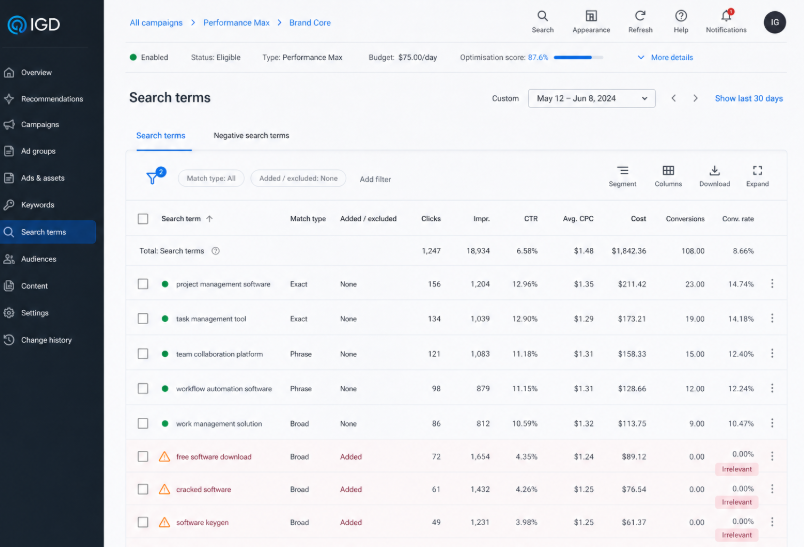
The search terms report is where you see what you are actually paying for. Not the keywords you chose. Not the campaign names. The real searches that triggered the ads. And when you look properly, it is often where wasted spend becomes obvious very quickly.
You might find job seekers, support queries, completely irrelevant searches, competitor terms you do not want, informational searches with no buying intent, or queries being picked up by the wrong campaign. None of these things are complicated to understand. They just need someone to actually look.
“There is so much focus on the next clever PPC tactic, but some of the easiest wins are much more basic. Open the search terms report, look at what people are actually typing, and ask yourself if you really want to be paying for it.”
Richie, Ignition Digital
Having negatives is not enough
The other pattern we saw was accounts that did have negative keywords, but had no clear structure around them.
We found shared lists mixed with individual negatives at account, campaign and ad group level. In some accounts it looked like different people had been adding terms for years, with no consistent naming convention and no obvious way to tell why something had been excluded.
That can be just as dangerous as having no negatives at all. If you cannot quickly understand what a negative is doing and where it is applied, it becomes very easy to block traffic you actually want.
In one audit we found an extensive brand negative list applied to the client’s main brand campaign. The campaign was getting zero traffic.
“This was a good reminder that simply having lots of negative keywords does not mean the account is well managed. In this case, somebody had applied the brand negative list to the actual brand campaign. It was blocking the exact traffic the campaign was there to capture.”
Richie, Ignition Digital
Make the boring stuff easy to understand
Our approach is pretty simple. We use organised negative keyword lists with a clear naming convention and a clear purpose. If somebody else opens the account, they should be able to understand what each list is doing without having to work backwards through years of changes.
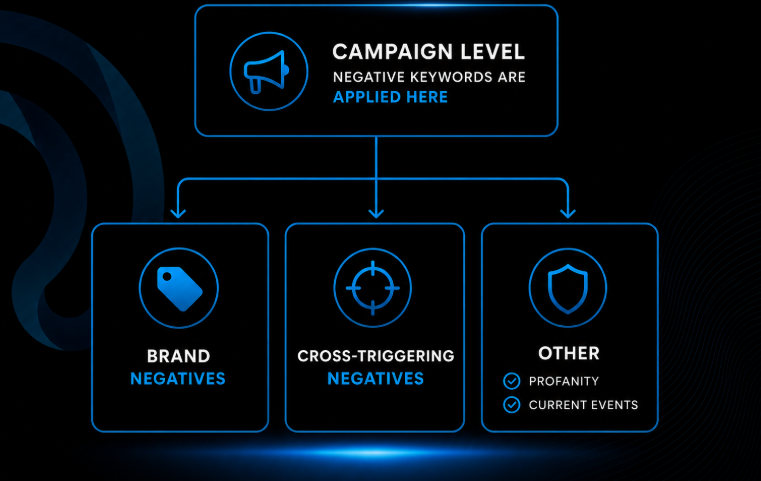
We normally keep brand negatives separate, use dedicated lists to control cross triggering between campaigns, and maintain a master negative list for terms that should be excluded across the account. Depending on the client, we can also have separate lists for things like profanity, sensitive searches and current events.
The point is not to create loads of lists for the sake of it. The point is to know what is being blocked, why it is being blocked and where that list should be applied.
That also makes future search term reviews much easier. You are not adding random negatives in random places. You have a structure to put them into, and you are much less likely to create problems further down the line.
What this can look like in practice
We have seen first hand how much of a difference this can make.
For one ecommerce account, we completely reworked the negative keyword structure after finding that search term management had become inconsistent over time. We introduced clearly defined negative lists, cleaned up existing exclusions and dealt with cross triggering between campaigns.
Nothing particularly exciting happened. We did not launch a new campaign type. We did not change the bidding strategy. There was no clever new AI tool involved.
In the first week after the new structure was implemented, ROAS increased by +34%.
We saw something similar with a B2B SaaS company. After reviewing the search terms and rebuilding the negative keyword structure, we were able to significantly reduce the amount of budget being spent on irrelevant and low intent searches.
Within the first month, CPA fell by -47%.
Of course, I would never suggest that every account is going to see results like these simply by adding a few negative keywords. Every account is different and there are always other factors that can influence performance. But it shows how much opportunity can be sitting in something as basic as the search terms report when it has not been managed properly.
“Neither of these involved anything earth shattering. We just spent the time going through the search terms properly, understanding where the wasted spend was coming from and putting a structure in place to control it. It is boring work, but if an account has not been doing it properly, the impact can be huge.”
Richie, Ignition Digital
PPC does not always need another clever tactic
There is a natural bias in our industry towards new things. A post about AI, automated bidding or a clever test is always going to sound more interesting than saying you reviewed search terms and cleaned up negative lists.
But I think we sometimes confuse new with better. The biggest gain in an account is not always buried inside some advanced strategy. Sometimes it is sitting in plain sight because nobody has spent enough time on the basics.
If an account is spending money on irrelevant searches, letting campaigns trigger for the wrong terms, or accidentally blocking good traffic, there is not much point obsessing over the next bidding tweak. Fix the obvious stuff first.
“I love testing new technology and new ways of working, but not every improvement has to be clever. Sometimes the quickest win is opening the search terms report and doing the boring work that nobody has bothered to do properly.”
Richie, Ignition Digital

Before you chase the next thing, check what you are paying for
This is not an argument against automation, AI or testing. We use all of them. They are a huge part of modern paid search.
It is just a reminder that the basics still matter.
Open the search terms report. Look at what is actually triggering your ads. Check whether irrelevant searches are being excluded. Check whether negatives are scattered around the account with no clear logic. Check whether campaigns are triggering against each other. And make sure the negatives that were supposed to protect performance are not blocking the traffic you actually want.
When more than half of the accounts we have audited this year had no negative keywords at all, it is hard to argue that this work is done and dusted.
The quickest win in PPC does not always need a new tool, a new bidding strategy or some clever breakthrough.
Sometimes you just need to be boring.
Connect with Ignition Digital
Website: https://ignitiondigital.io
LinkedIn: https://www.linkedin.com/company/ignition-digital-services-ltd/
Richard O’Sullivan: https://www.linkedin.com/in/richard-o-sullivan-000b7ab7/