


 Published by Sue Johns-Chapman
Published Date 07.10.2026
Published by Sue Johns-Chapman
Published Date 07.10.2026 
By Will Bagnall, CEO and Founder, SUSO Digital
In 2005, a handful of companies decided organic search was a real channel and went after it properly. TripAdvisor and Yelp still sit at the top of Google for their categories twenty years later. Nobody who came in late has moved them.
AI search is at that point now. In most categories, no brand has become the default answer yet. The early adopter advantage is being decided as we speak.
Our clients and agency partners are past asking whether to invest in GEO. The question we hear now is: how will we know it’s working? Most agencies can’t answer that yet, and that is the real gap in the market.
My view is simple. Measurement is the first step in GEO, not the last. If you can’t show a client where they’re cited today, you can’t scope the work, prove progress or defend the budget. That’s why we built SUSO’s AI Search Visibility Checker, a finalist for Best AI Search Software Solution at the 2026 Global Search Awards.
Your current reporting starts after the click
GA4 and Search Console are where most agencies look first. Neither was built for this.
Search Console’s Generative AI performance report, which Google rolled out widely this summer, shows impressions in AI Overviews and AI Mode. It doesn’t show the queries behind them, clicks, or where your link sits inside the answer. It only covers Google. ChatGPT, Perplexity and Claude will never appear there.
GA4’s AI Assistant channel counts sessions that came from AI referrals. It only sees people who clicked through after being cited, and some AI platforms strip referrer data, so part of that traffic still lands as Direct.
Neither tells you how often you were cited, how you were described, or who was recommended instead of you. That’s the part that decides whether the click ever happens.
Why it’s hard to measure
No query data. ChatGPT, Perplexity and Claude don’t share what users type, and there’s no sign that will change. Google’s report shows that a URL appeared in an AI feature, not what prompted it.
Answers change every time. Ask an LLM the same question twice and you get two different answers. We regularly see a brand cited in most responses to one prompt and a fraction of responses to a near-identical one. One snapshot tells you very little. You need volume, across several versions of each prompt.
Every platform is different. ChatGPT, Gemini, Perplexity and Claude use different training data and different retrieval logic. Measure one and assume the rest, and you’ll get the wrong answer.
There’s no “position one”. A top Google ranking is unambiguous. In an AI answer, a brand might be the lead recommendation with a link, a passing mention halfway down, or named with no link at all. Most tools flatten that into present or absent. Google has the same problem: in September, John Mueller said position for these features is “hard to do in a way that makes it useful”, so Search Console counts the whole AI block as one position.
What we measure
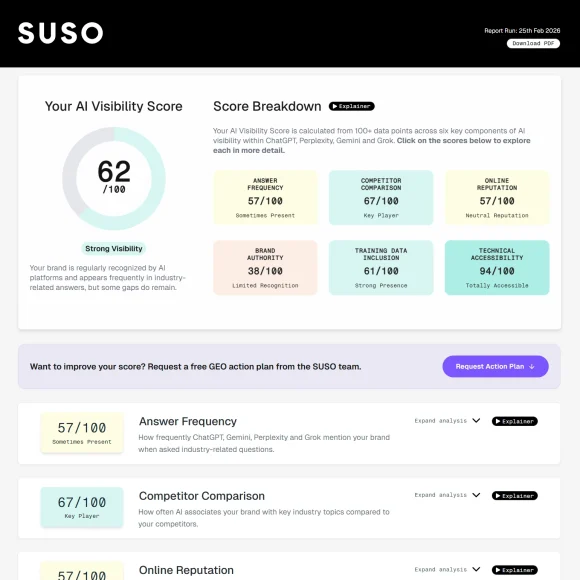
We built the checker around those four problems. It runs live queries across the major AI platforms at volume, scores more than 100 signals and returns a report in a few minutes. It’s free and needs no account. The signals fall into six areas:
- Answer frequency: how often AI tools cite the brand across different prompt types
- Share of voice: how the brand compares with competitors in the same answers
- Sentiment: how positively or negatively AI describes the brand
- Technical accessibility: whether AI crawlers can reach and read the site
- Training data presence: whether the brand appears in the sources models learn from
- Brand authority: the wider signals that make a citation more likely
Run it once and you have a baseline. Run it regularly and you can see whether a brand is gaining ground or losing it.
A score is a curiosity. A competitor winning is a problem.
A visibility score on its own rarely moves a client. “A competitor is being recommended instead of you in most of your buying-intent prompts” does. That’s why share of voice matters as much as citation rate. The question isn’t whether a brand appears. It’s whether it appears more often than the brands it competes with.
The other areas people skip are technical accessibility and training data. They usually get tackled last, but they come first in the chain. If AI crawlers can’t read the site, or the brand barely exists in the sources models draw on, no amount of content work will earn citations.

Where agencies come in
Most brands won’t build GEO in-house. They’ll ask the agency they already work with. A lot of PR, marketing and web design agencies are getting that question right now without a way to answer it.
GEO work covers three areas: content that LLMs want to cite, technical fixes so AI crawlers can access the site, and PR and authority building. Measurement sits underneath all three. It tells you what to prioritise, whether the work is moving the needle, and what to show a client when they ask about progress.
The most useful thing an agency can take into a client meeting is a gap report: where the client is cited, where they aren’t, and who is being chosen instead. That turns a vague conversation about AI search into a specific problem with a specific fix.
Building that capability yourself is harder than it looks. Prompts need constant refinement, platforms keep changing, and results vary from run to run. For most agencies, partnering with someone who has already built it is the faster route.
So start with a baseline. Run the AI Search Visibility Checker on a client or prospect domain. It takes a few minutes and there’s no sign-up.
About the author
Will Bagnall is CEO and Founder of SUSO Digital, an SEO and AI search (GEO) agency. SUSO works directly with brands and partners with PR, marketing, web design and SEO agencies across the US and UK on a white-label basis.
SUSO Digital are Global Search Awards 2026 finalist for Best Low Budget Campaign (SEO) and Best AI Search Software Solution.